BTh Bachelor of Theology

Why Pursue a Bachelor of Theology?

In today’s rapidly changing world, the church needs leaders who are spiritually grounded, theologically informed, and able to respond wisely to the needs of society. The Bachelor of Theology (BTh) at AFM Theological College equips students with the knowledge, skills, and ministry competencies required for meaningful Christian leadership.

Whether you are called to pastoral ministry, missions, teaching, chaplaincy, community development, or church leadership, this programme provides a strong biblical and theological foundation while remaining relevant to real-world ministry contexts.

At AFMTC, the programme is shaped by:

  • A Pentecostal and missional ethos.

  • An academic excellence –  integrated with practical ministry formation. 

  • Relevance to South African and global ministry contexts.

  • Flexible online delivery suited to working adults and ministry leaders.

Students have the opportunity to pursue a fully accredited Bachelor of Theology degree awarded by AFMTC, which may form part of the pathway toward possible ordination in the AFM of SA (where all additional church requirements are met).

Fully Accredited. Registered with the Department of Higher Education and Training until 31 December 2028 as a Private Higher Education Institution under the Act. Registered in accordance with section 54(6)(b) of the Act and Regulation 16. Official Registration Certificate Number: 2025/HE08/002

Bachelor of Theology Overview

AFM Theological College is provisionally registered with the Department of Higher Education and Training (DHET) as a Private Higher Education Institution (PHEI). Registration Certificate Number: 2025/HE08/002

The Bachelor of Theology (BTh), NQF Level 7 (SAQA ID 123825) is fully accredited by the Council on Higher Education (CHE) and registered on the National Qualifications Framework (NQF) by SAQA.

The programme offers a comprehensive grounding in:

  • Old Testament & New Testament Studies.

  • Systematic & Practical Theology.

  • Church History & Missiology.

Students develop skills in:

  • Biblical interpretation and exegesis.

  • Preaching, teaching, and pastoral care.

  • Leadership and ministry practice.

  • Academic writing and theological reflection.

Elective options include Greek, Hebrew, Philosophy, and Christian Spirituality.

Do I Qualify?

To register for the BTh, applicants must normally have:

  • A National Senior Certificate (NSC) granting admission to degree studies, or an equivalent qualification, OR

  • A recognised tertiary qualification (South African or international) from an accredited institution.

Applicants must submit certified copies (dated within the last 3 months) of:

  • School-leaving certificate or prior qualification.

  • Identity document or passport.

Applicants must demonstrate sufficient English language proficiency to engage in academic study. All applications for admission must be submitted online during the prescribed application period. For more information on application and enrolment, please visit the Application Instructions Page.

If direct entry requirements are not met, the student may start through one of the recognised pathway programmes with AFMTC partner institutions. There are two alternative pathways to the BTh Degree. 

Alternative Pathway 1:
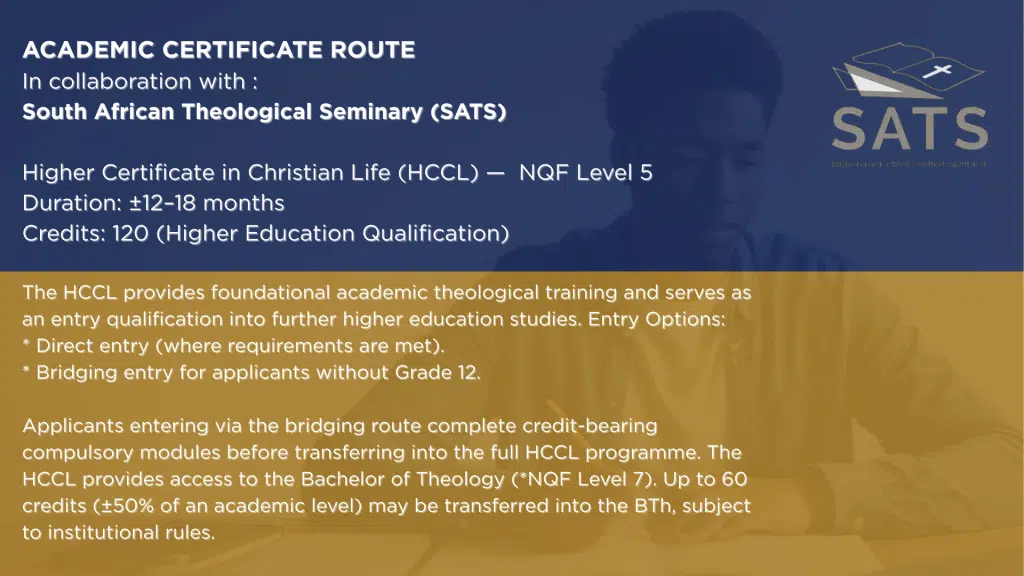
Alternative Pathway 2:

Degree Outline

  • Qualification: Bachelor of Theology (BTh) | NQF Level: 7 | Total Credits: 360 credits | Mode of Delivery: Online Learning. | Language of Instruction: English.

Programme Length & Study Load. Students may study at a flexible pace. | Minimum requirement: 48 credits per 12-month period. | Typical Study Load: 4–6 modules per semester. | Faster Pace: Up to 10 modules per semester (where appropriate). | Normal completion ranges from 3–6 years, depending on workload.

Semesterisation. AFMTC follows a semesterised structure. | All modules are presented every semester. | Students may register according to capacity and progression requirements.

Prerequisites. Some modules require successful completion of a prior module. Example: NTS101 must be completed before NTS102.

Electives. Elective streams are chosen in first year and continued to third year to ensure academic coherence.

Online Learning Requirements. To complete your studies, you will need:

  • A computer or laptop.

  • Reliable internet access.

Learning takes place through an online student platform that serves as the central learning and communication hub.

Recognition of Prior Learning (RPL).  AFMTC may recognise: prior accredited qualifications and/or relevant ministry or professional experience. Where applicable, credits may be awarded toward modules in the BTh, in line with policy and regulatory requirements.

Postgraduate Readiness. Graduates are well prepared to continue to postgraduate theological studies, subject to institutional entry requirements.

BTh Curriculum Structure

Module Selection Rules (per semester). 

  • Group A: Select minimum 1 and maximum 2 modules.

  • Group B: Select minimum 2 and maximum 6 modules.

  • Group C (Electives): Select minimum 1 and maximum 2 modules.

  • Keep prerequisite and progression rules in mind when registering. All modules run every semester, except Greek and Hebrew, which are annual (12-month) modules.

Group A: Core Modules (All compulsory)
(Select 1–2 per semester)
ModuleCodeCredits
Introduction to the Study of TheologyTHS1016
Basic Academic Writing Skills 1AWS1026
Bible Languages and Cultures 1BLC1016
Basic Principles of LeadershipPLS1026
Group B: Core Discipline Streams (All compulsory)
(Select 2–6 per semester — 101 must be completed before 102)
ModuleCodeCredits
Old Testament Studies 101OTS1016
Old Testament Studies 102OTS1026
New Testament Studies 101NTS1016
New Testament Studies 102NTS1026
Church History 101CHS1016
Church History 102CHS1026
Missiology 101MSS1016
Missiology 102MSS1026
Systematic Theology & Ethics 101STE1016
Systematic Theology & Ethics 102STE1026
Practical Theology 101PTS1016
Practical Theology 102PTS1026
Group C: Electives (Choose TWO elective streams)
(Select 1–2 per semester — electives continue to Levels 2 & 3)
ModuleCodeCredits
Greek 1 (Annual Module)GRK111 & GRK11212
Hebrew 1 (Annual Module)HEB111 & HEB11212
Philosophy 101PHL1116
Philosophy 102PHL1126
Christian Spirituality 101CSP1116
Christian Spirituality 102CSP1126

Total Credits — First Level: 120


Group A: Core Modules (All compulsory)
(Select 1–2 per semester)
ModuleCodeCredits
Theological Studies and the MinistryTHS2016
Intermediate Academic Writing Skills 2AWS2026
Bible Languages and Cultures 2BLC2016
Intermediate Principles of LeadershipPLS2026
Group B: Core Discipline Streams (All compulsory)
(Select 2–6 per semester — 201 is prerequisite for 202)
ModuleCodeCredits
Old Testament Studies 201OTS2016
Old Testament Studies 202OTS2026
New Testament Studies 201NTS2016
New Testament Studies 202NTS2026
Church History 201CHS2016
Church History 202CHS2026
Missiology 201MSS2016
Missiology 202MSS2026
Systematic Theology & Ethics 201STE2016
Systematic Theology & Ethics 202STE2026
Practical Theology 201PTS2016
Practical Theology 202PTS2026
Group C: Electives (Same streams continued)
(Select 1–2 per semester — prerequisites apply)
ModuleCodeCredits
Greek 2 (Annual Module)GRK211 & GRK21212
Hebrew 2 (Annual Module)HEB211 & HEB21212
Philosophy 211PHL2116
Philosophy 212PHL2126
Christian Spirituality 211CSP2116
Christian Spirituality 212CSP2126

Total Credits — Second Level: 120


Group A: Core Modules (All compulsory)
Select 1–2 per semester
ModuleCodeCredits
Research in Theological StudiesAWS3016
BTh Formative ProjectTHS3026
Bible Languages and Cultures 3BLC3016
Advanced Principles of LeadershipPLS3026
Group B: Core Discipline Streams (All compulsory)
(Select 2–6 per semester — 301 is prerequisite for 302)
ModuleCodeCredits
Old Testament Studies 301OTS3016
Old Testament Studies 302OTS3026
New Testament Studies 301NTS3016
New Testament Studies 302NTS3026
Church History 301CHS3016
Church History 302CHS3026
Missiology 301MSS3016
Missiology 302MSS3026
Systematic Theology & Ethics 301STE3016
Systematic Theology & Ethics 302STE3026
Practical Theology 301PTS3016
Practical Theology 302PTS3026
Group C: Electives (Final level of same streams)
(Select 1–2 per semester)
ModuleCodeCredits
Greek 3 (Annual Module)GRK311 & GRK31212
Hebrew 3 (Annual Module)HEB311 & HEB31212
Philosophy 311PHL3116
Philosophy 312PHL3126
Christian Spirituality 311CSP3116
Christian Spirituality 312CSP3126

Total Credits — Third Level: 120


Notes for Students:

  • Elective streams chosen in First Level must continue through Levels 2 and 3.

  • Greek and Hebrew are annual modules (12 months).

  • All other modules run per semester.

  • Prerequisite rules apply (e.g., NTS101 → NTS102 → NTS201 → NTS202 …)

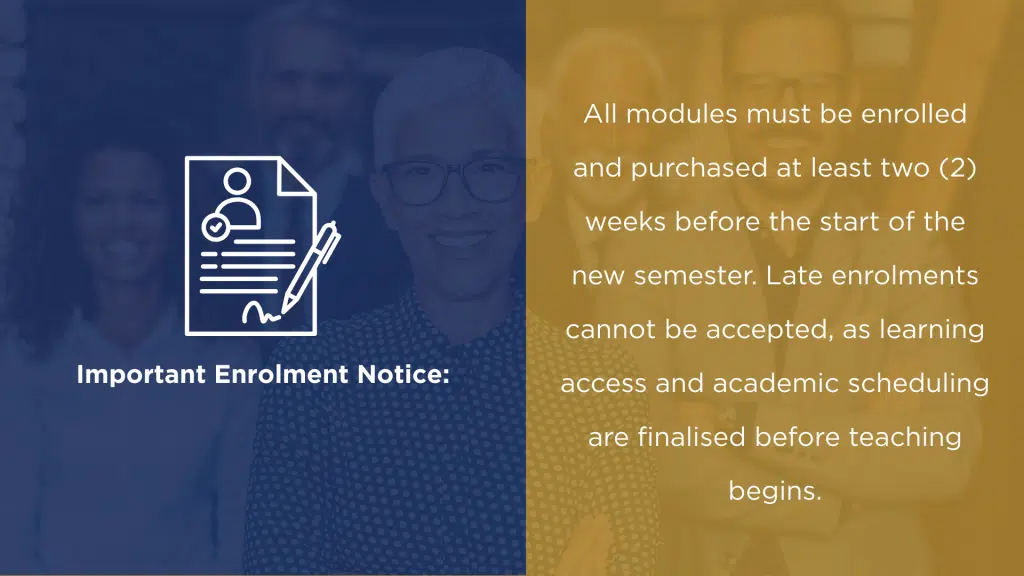
  • Remember: Modules must be enrolled and purchased at least two weeks before the semester starts. 

Timetable

The programme operates on a semester-based academic calendar.All modules are offered each semester, allowing students to plan their studies flexibly according to prerequisites and workload capacity.

Academic Calendar — 2026

SemesterStart DateEnd Date
Semester 123 February 202613 June 2026
Semester 220 July 202621 November 2026

Pricing

Fees are charged per module, allowing students to register for a manageable number of modules per semester. | Recognition of Prior Learning (RPL), where approved, may reduce the number of modules required.

South African Pricing — Bachelor of Theology

CategoryItem / DescriptionFee
Application & EnrolmentApplication Fee (once-off)Free
 Enrolment Fee (once-off)R 2,000
Modules6-Credit ModuleR 1,625
 12-Credit ModuleR 3,250
Other ServicesRPL Fee (once-off)R 2,500
 Re-assessment FeeR 500
 Special LettersR 120
 TranscriptR 200
 Re-activation FeeR 500
 

Note to Students: Please be advised that for certain modules, students are required to independently purchase prescribed textbooks at their own cost, providing greater flexibility in sourcing these materials.

Rules for Assessment, Credit Accumulation, Progression and Qualification

Assessment

AFMTC uses both formative and summative assessment in the Bachelor of Theology. 

Formative assessment
Formative assessment takes place during the semester and may include assignments, online discussions, tests, book reports, essays or other learning activities. These assessments:

  • Support learning and provide feedback on progress.

  • Help prepare students for the final (summative) assessment.

  • Are developmental in nature and do not award credits on their own.

  • Require students to achieve a minimum semester mark of 40% in order to gain admission to the summative assessment. 

Summative assessment
Summative assessment takes place at the end of the semester and may consist of a written examination or a portfolio of evidence (such as an examination essay or presentation). To qualify for the summative assessment, students must:

  • Submit all required assignments and complete all tests, and

  • Obtain a minimum semester mark of 40%.

To pass a module, students must obtain:

  • An overall final mark of 50% or higher, and

  • A minimum of 40% in the examination or portfolio component (sub-minimum requirement).

External moderation is applied to final-year assessments to ensure academic quality and fairness.

Credit Accumulation

Each module carries a specific credit value that contributes toward the qualification. Credits are awarded only when a student successfully passes a module.

  • The BTh requires a total of 360 credits.

  • Students must complete at least 120 credits at third-year (NQF Level 7).

  • Credits accumulate progressively across all three levels of study.

Students receive an academic transcript reflecting all modules completed and credits earned.

Progression

Students progress through the programme by completing modules in the correct sequence and prerequisite order (for example: 101 → 102 → 201 → 202).

Progression requirements include:

  • Meeting all prerequisite module requirements.

  • Achieving required semester marks and pass marks.

  • Maintaining satisfactory academic progress.

  • Continuing in the same elective streams across Levels 1–3.

Students who experience academic difficulty may be referred for additional support or study advising.

Qualification Requirements

To be awarded the Bachelor of Theology (BTh) degree, a student must:

  • Successfully complete all prescribed modules.

  • Accumulate 360 credits in accordance with programme rules.

  • Complete at least 120 credits at Level 7 (third year).

  • Meet all assessment and progression requirements.

Once all programme requirements are fulfilled, the qualification is formally awarded.

APPLY HERE

Table of Contents

Application Period Updates

Applications for the First Semester of 2025:

Applications for the first semester of 2025 are open from 1 August 2024 to 31 October 2024. Stay tuned for updates and explore other opportunities with us.

Thank you!